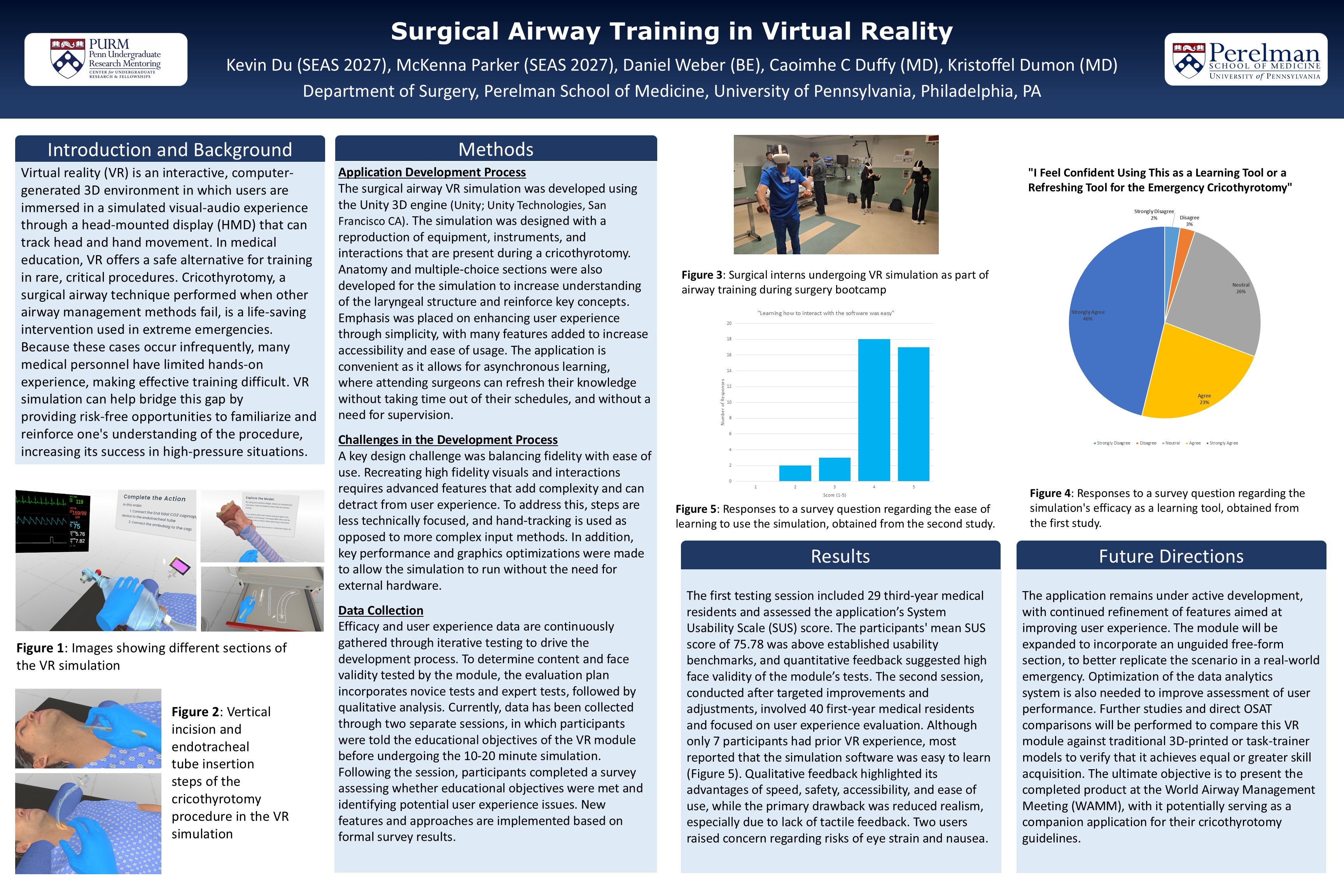
Virtual reality
Surgical Airway Training in Virtual Reality
Kevin Du · McKenna Parker
A hands-on VR simulation for emergency airway training, developed in Unity with hand tracking and evaluated with surgical residents.
View full poster
Our lab works closely with undergraduate students through structured research and design mentorships focused on immersive technology, surgical education, and interactive systems. Students contribute to real projects used in research, education, and clinical training—working alongside engineers, clinicians, and faculty mentors. Mentorships emphasize hands-on development, technical rigor, and thoughtful design, while supporting students at different stages of their academic and professional paths.
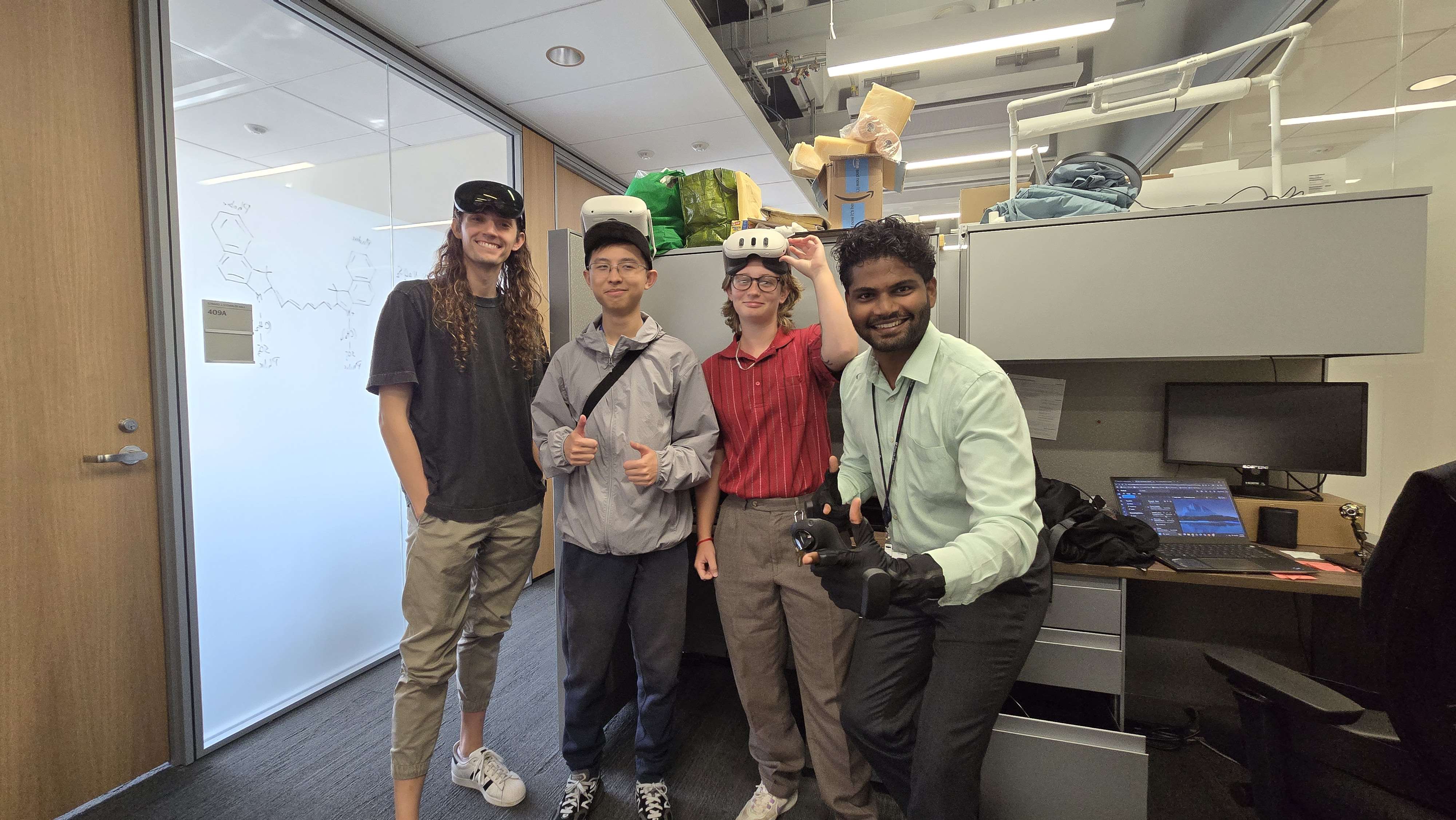
Through the PURM program, undergraduate students join the lab for focused summer research experiences. Students contribute directly to active projects in virtual reality, simulation tooling, and interactive surgical education. PURM mentorship emphasizes learning by doing: students prototype systems, test ideas, and iterate alongside lab mentors while gaining exposure to interdisciplinary collaboration in a clinical research environment.
We have hosted students through Drexel University’s Cooperative Education (Co-op) program for extended, full-time placements. Co-op students embed deeply into the lab’s development workflow and take ownership of substantial technical and creative work.Projects often span real-time 3D environments, VR interaction systems, tooling pipelines, and experimental research prototypes, offering students industry-relevant experience within an academic and clinical setting.
The lab supports Penn junior-level design projects and independent research efforts that explore immersive technology, healthcare simulation, and human–computer interaction. Students work in small teams to scope, design, and build feasible projects under close mentorship.These projects emphasize problem definition, technical execution, and communication—often contributing prototypes, tools, or studies that inform ongoing lab research.
UNDERGRADUATE RESEARCH
Explore five student research posters spanning immersive simulation, artificial intelligence, and accessible surgical training. Select a poster to read the full project.
Virtual reality
Kevin Du · McKenna Parker
A hands-on VR simulation for emergency airway training, developed in Unity with hand tracking and evaluated with surgical residents.
View full poster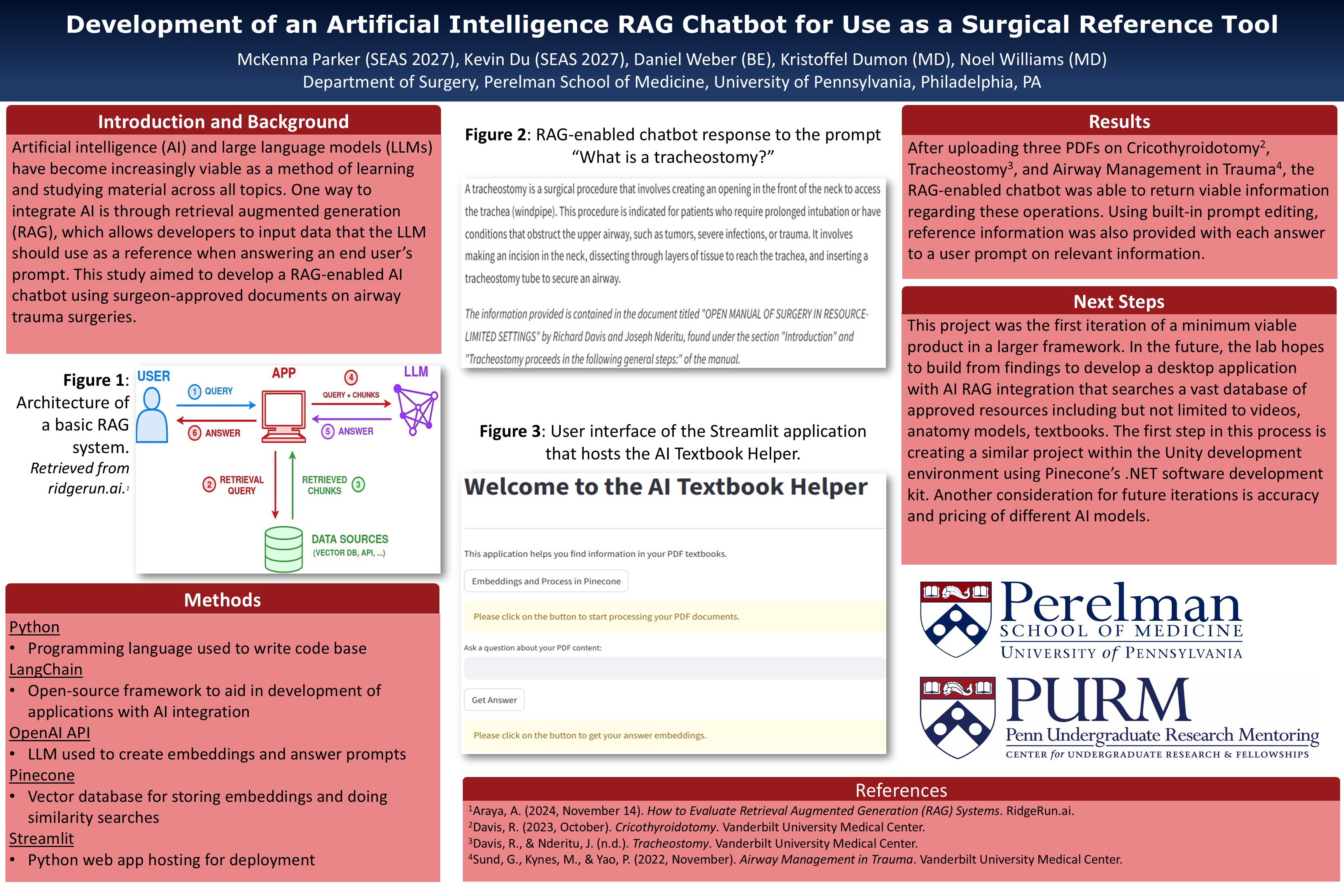
Artificial intelligence
McKenna Parker · Kevin Du
A retrieval-augmented generation (RAG) prototype that answers surgical questions using a curated collection of surgeon-approved reference documents.
View full poster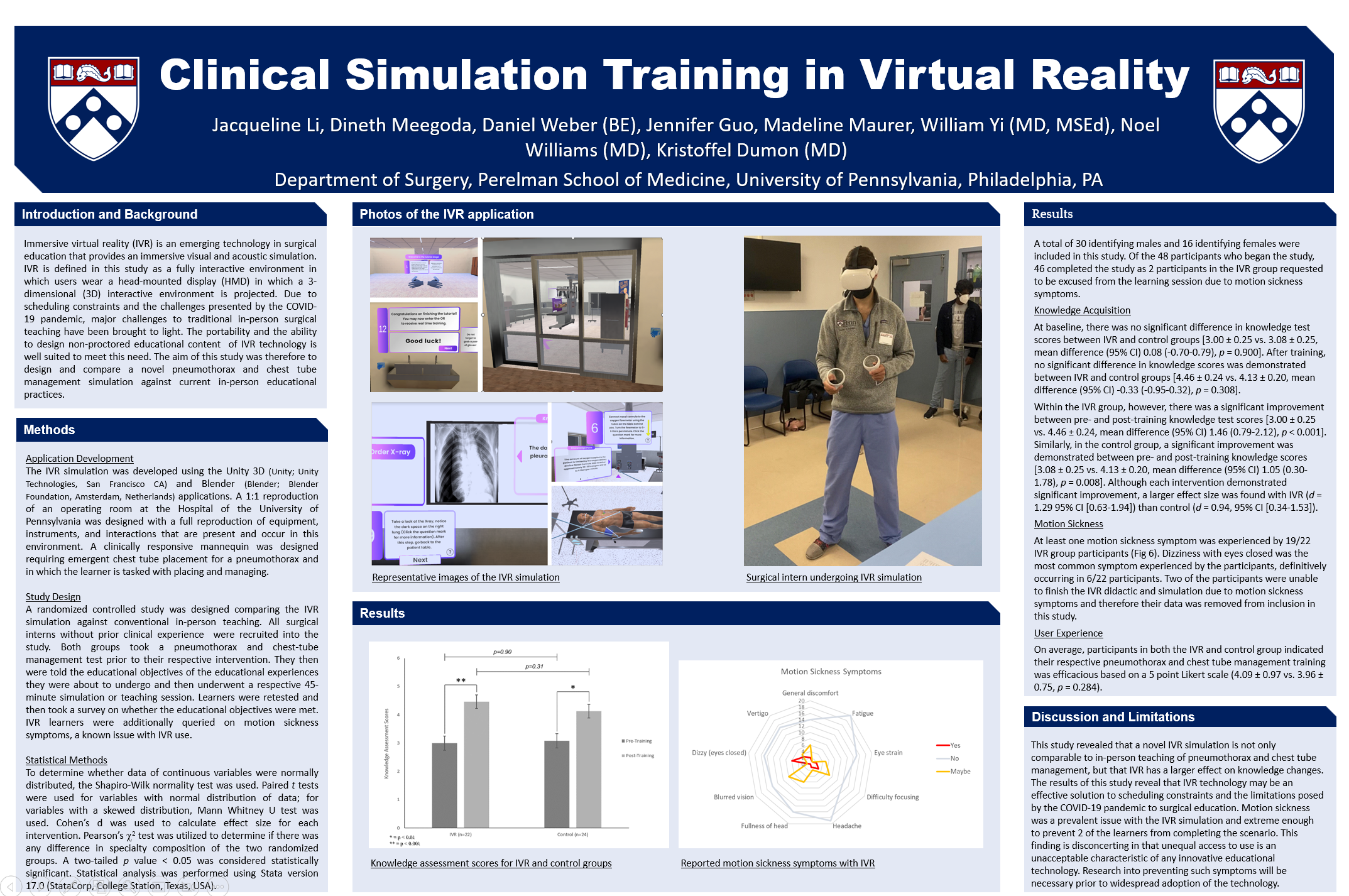
Clinical simulation
Jacqueline Li · Dineth Meegoda
An immersive pneumothorax and chest-tube management simulation, studied alongside conventional in-person training to assess learning and user experience.
View full poster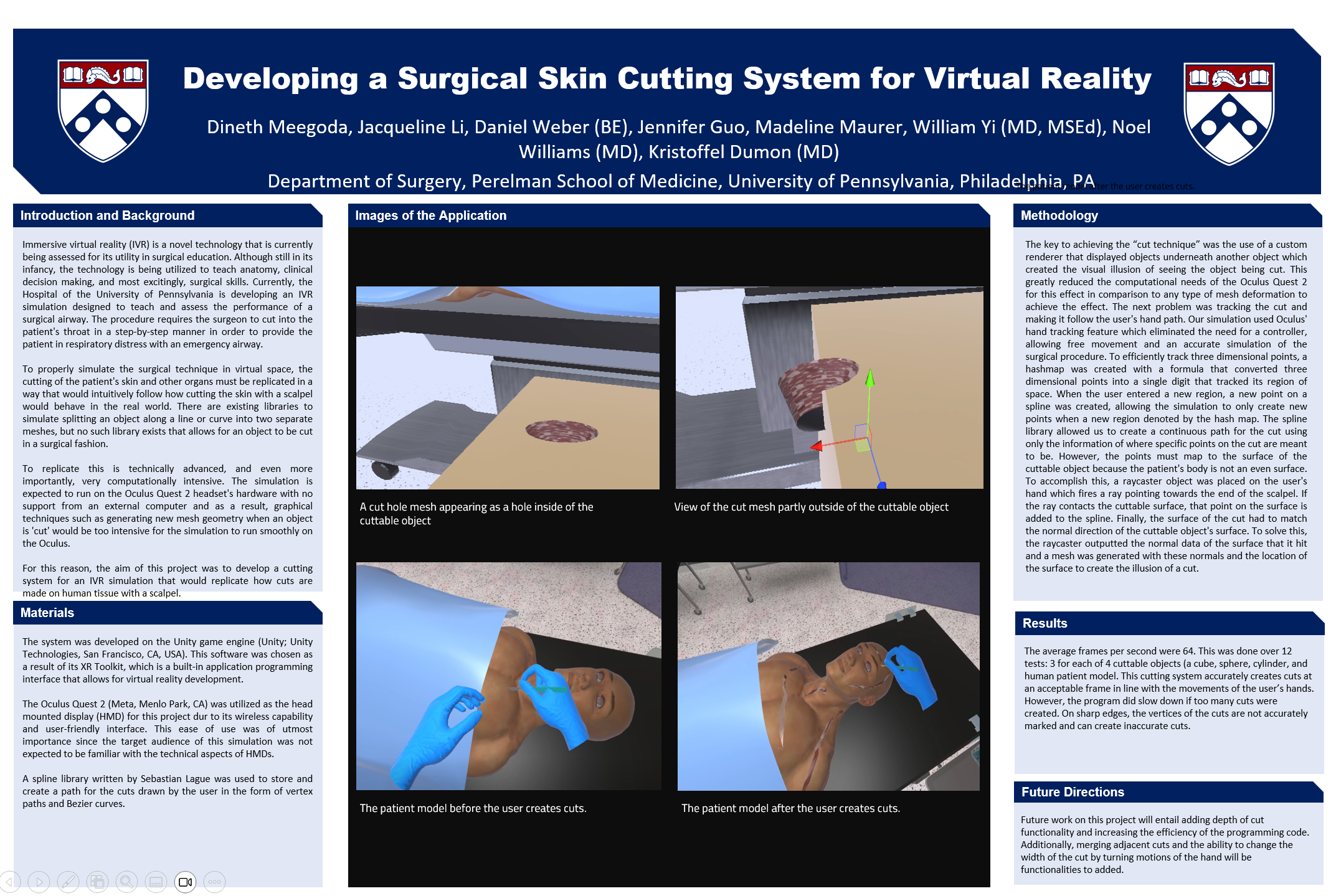
Simulation development
Dineth Meegoda · Jacqueline Li
A real-time skin-cutting system that follows the learner’s hand movements, bringing surgical incision practice to a standalone VR headset.
View full poster
Augmented reality
Sebastian Pizarro
A customizable, multilayer suture pad paired with an augmented reality training environment to explore more accessible surgical skills practice.
View full poster
